Why Hard Shell Polycarbonate Suitcases Survive Travel Better
Your suitcase gets dropped off a baggage cart, stacked under three heavier bags, and dragged across a conveyor belt, all before you've even cleared immigration. Repeat that across a year of travel, and most luggage starts showing it: cracked corners, popped wheels, a zipper that won't sit flush anymore. The suitcases that hold up aren't lucky. They're built from the right material in the first place.
What actually happens to a suitcase in transit
Checked luggage doesn't get carried so much as it gets thrown, slid, and compressed. It's loaded onto carts, dropped into cargo holds, stacked under other bags, and run through automated sorting systems that aren't gentle by design. None of this is mishandling in the legal sense. It's just what high-volume baggage systems look like, and your suitcase has to survive it as routine, not as an exception.
This is exactly why soft-sided fabric luggage and cheaper ABS plastic shells age fast. Fabric absorbs scuffs and tears at the seams. Basic ABS plastic is rigid but brittle, so it cracks under sharp impact rather than flexing and recovering.
Why does polycarbonate behave differently
Polycarbonate is the same category of material used in safety goggles and riot shields, chosen specifically because it can flex under impact and return to shape instead of cracking. When a polycarbonate suitcase takes a hard knock, the shell absorbs the energy and flexes, rather than transferring all of it into a crack point the way more rigid materials do.
This matters most at corners and edges, which take the brunt of every drop and every stack. A well-built polycarbonate shell, often reinforced with ribbing or a double-layer construction at stress points, keeps its shape trip after trip instead of slowly developing the dents and hairline cracks that show up on cheaper hard shells within a year.
It's not just the shell material
A genuinely durable suitcase is a system, not a single material choice. The shell handles impact, but wheels, zippers, and the handle mechanism take their own kind of abuse.
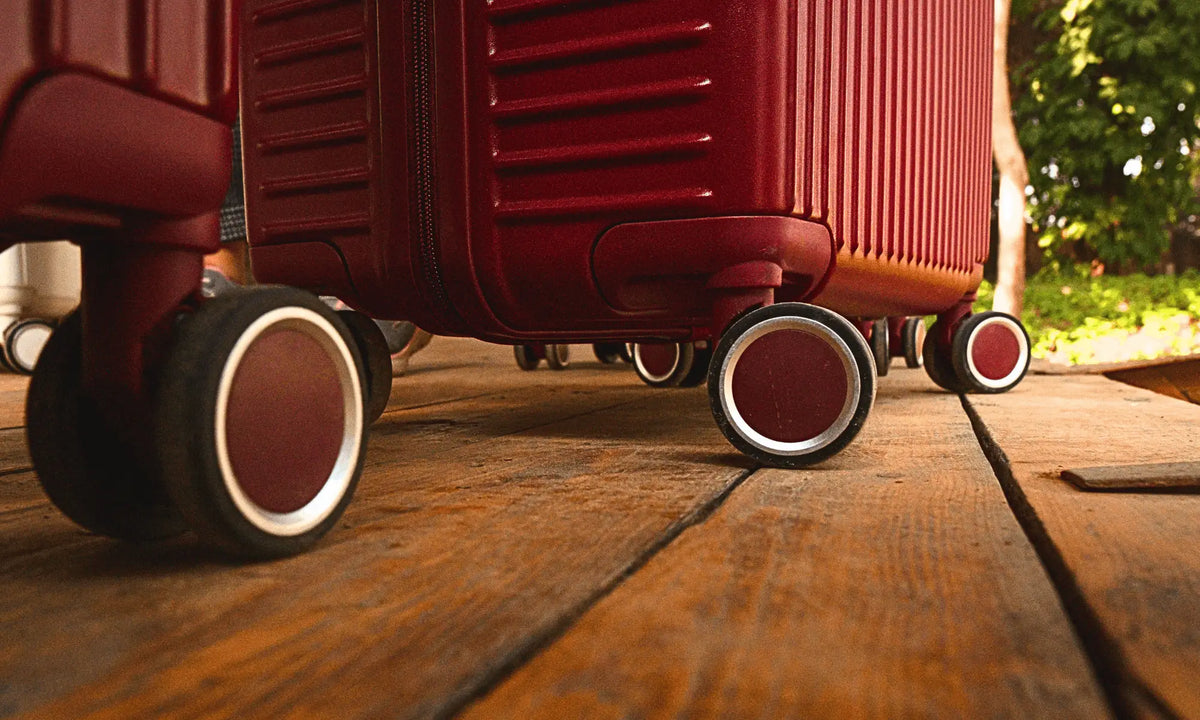
Spinner wheels: Eight-wheel spinner setups (four dual wheels) distribute weight better and roll straighter than two fixed wheels, which reduces strain on the wheel housing over time, a common failure point on lower-quality luggage.
Zippers and seams: On a true hard shell, the zipper track sits in a moulded groove rather than relying on stitched fabric, which means there's no seam to fray or tear under pressure.
Telescopic handle: A handle that retracts fully and locks at full extension without wobble tells you something about the overall build quality, since it's one of the more mechanically complex parts of any suitcase.
How to tell durability apart from marketing
Almost every hard luggage brand claims "durable" on the box. The way to actually check is to look past the word and at the construction details: shell thickness at the corners, whether the wheels are recessed or exposed, and whether the brand specifies the exact grade of polycarbonate used rather than just naming the material.
A heavier-feeling shell isn't automatically more durable, and a very light one isn't automatically fragile. What matters is whether the shell has reinforcement exactly where impact concentrates, which is usually the corners and the area around the wheel housings.
FAQs
Is polycarbonate better than ABS for luggage?
Generally yes for durability. Polycarbonate flexes and absorbs impact, while ABS is more rigid and prone to cracking under sharp or repeated impact, especially at corners.
Can a polycarbonate suitcase still crack?
Under extreme force, yes, but it takes significantly more impact than ABS or basic hard plastic shells, which is why polycarbonate is the standard choice for premium hard luggage.
Does a heavier suitcase mean it's more durable?
Not directly. Durability comes from shell construction and reinforcement at stress points, not raw weight. A well-engineered lightweight shell can outlast a heavier, poorly reinforced one.
The next time a suitcase survives a rough connection or a dropped transfer without a mark, that's not chance. That's the shell doing exactly what it was built to do.

Written by Dismantle Digital PLC.